SIC-MMAB - Synchronisation Involves Communication in Multiplayer Multi-Armed Bandits
Meta
Tag: #articles/tags/Computer_Science__Machine_Learning, #articles/tags/Statistics__Machine_Learning, #articles/tags//unread
citekey: boursierSICMMABSynchronisationInvolves2019
authors: #articles/authors/Etienne-Boursier, #articles/authors/Vianney-Perchet
year: 2019/11/19
doi: 10.48550/arXiv.1809.08151
url: http://arxiv.org/abs/1809.08151
conference: #articles/conference/
Journal : #articles/journals/
Abstract
Motivated by cognitive radio networks, we consider the stochastic multiplayer multi-armed bandit problem, where several players pull arms simultaneously and collisions occur if one of them is pulled by several players at the same stage. We present a decentralized algorithm that achieves the same performance as a centralized one, contradicting the existing lower bounds for that problem. This is possible by “hacking” the standard model by constructing a communication protocol between players that deliberately enforces collisions, allowing them to share their information at a negligible cost. This motivates the introduction of a more appropriate dynamic setting without sensing, where similar communication protocols are no longer possible. However, we show that the logarithmic growth of the regret is still achievable for this model with a new algorithm.
Note
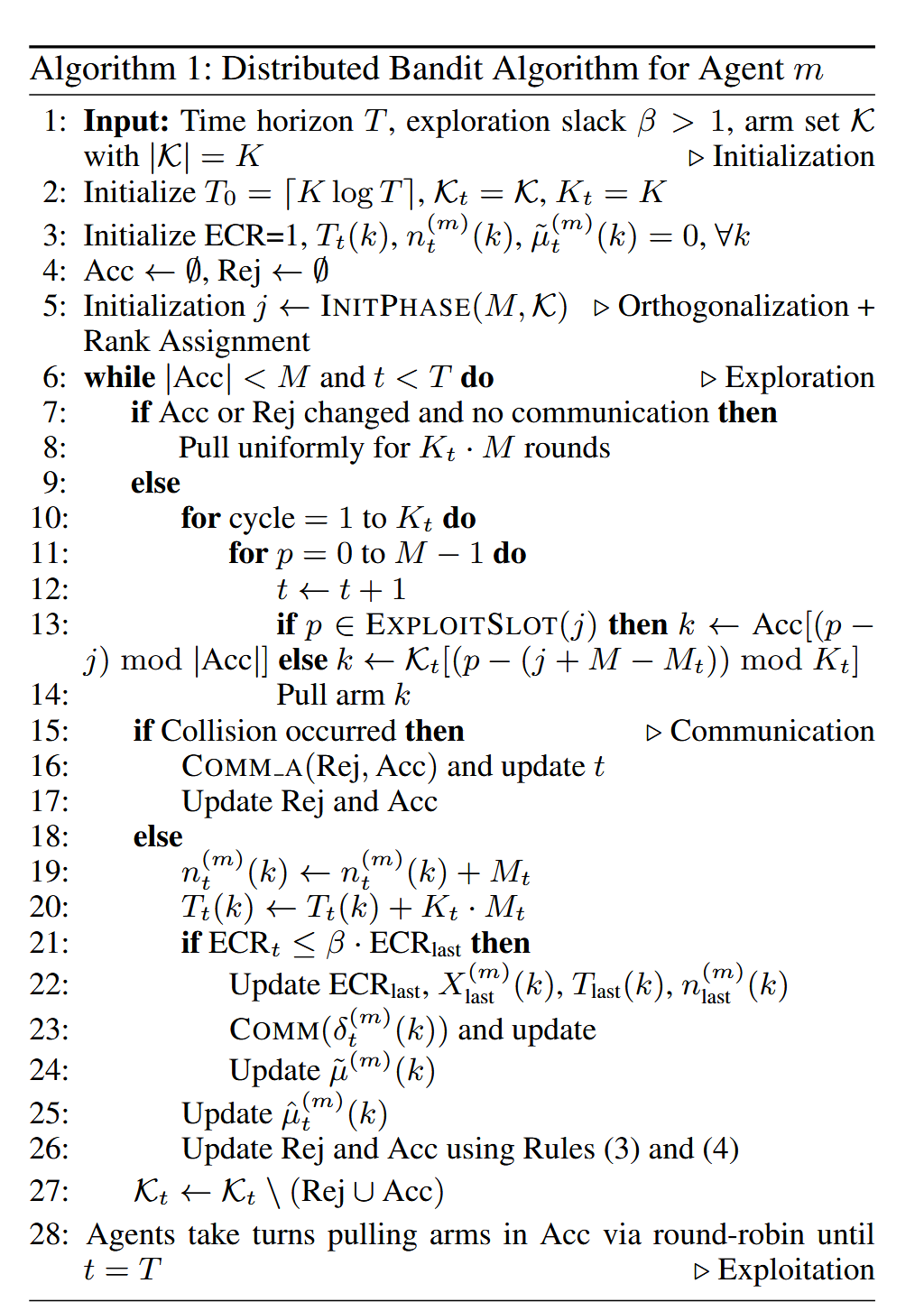
1. initialization
在这个阶段作者采用了两个protocol, 并且由此使得每一个agent自身能够identify整个system里有多少个agent()以及自己所在的内部排名()
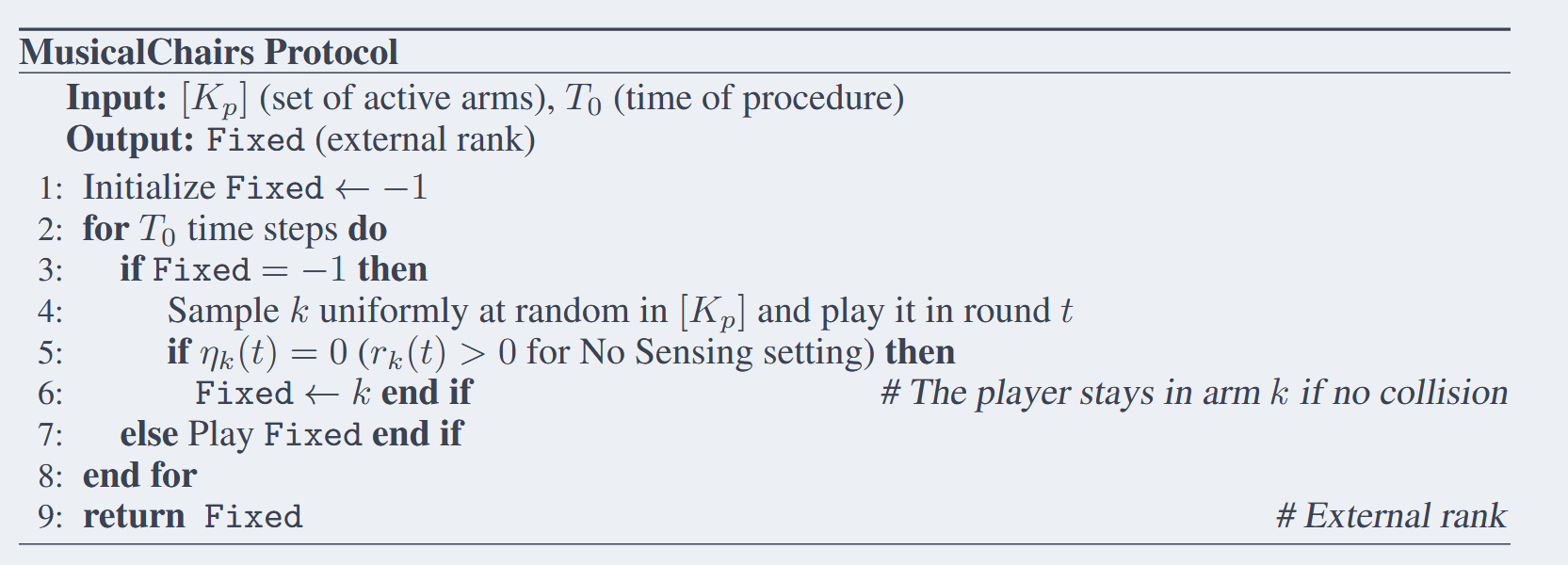
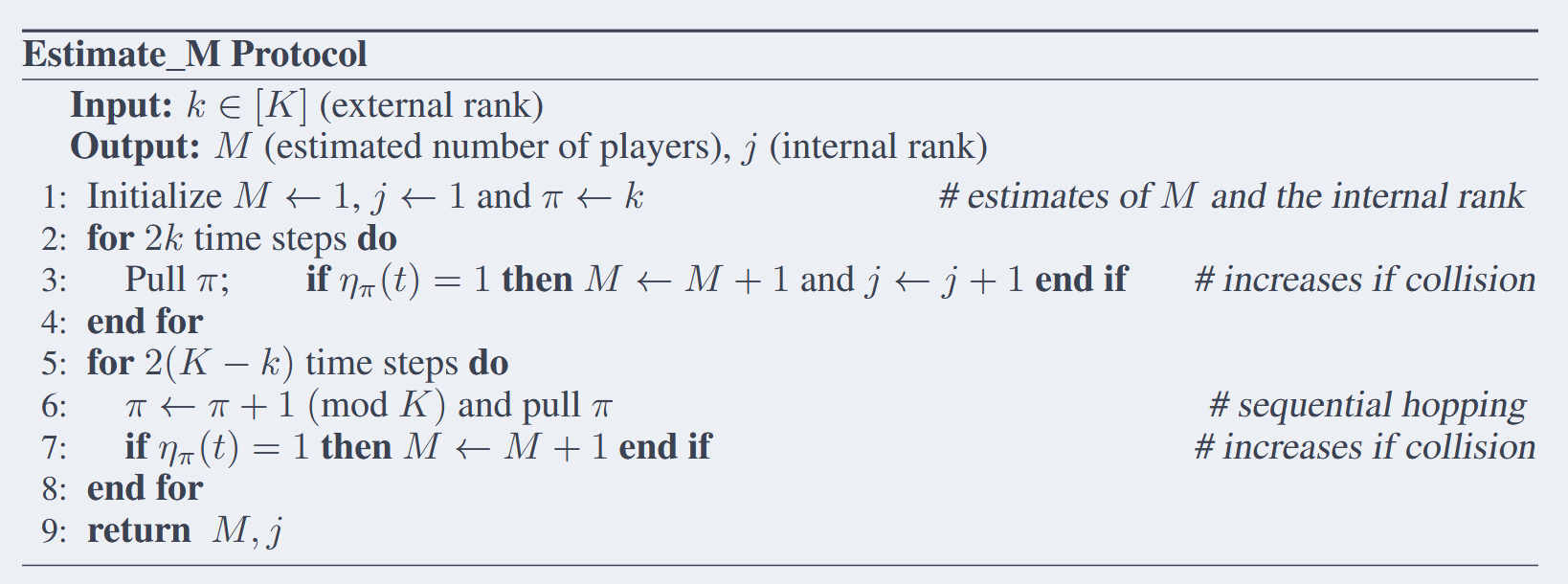
MusicalChairs: 先每个人fix一个对应的arm, 这样便可以获得external rank, 但是由于这个external rank并不一定是连续的, 所以还要配合第二步
Estimate_M:
- 这个算法的核心思想是: 每个agent所在的arm要和序号在他前面的所有人发生collision, 由此可以得到自己的internal rank(这是实际的连续排名), 其次每个agent还要和自己后面的所有agent发生碰撞, 以此得到整个system内部到底有多少人.
- 那么为什么每个arm都要sample自己次??
每个arm不是只需要sample 次就够了吗?只sample k次会发生很严重的问题, 就是会导致前面的agent在和"我"发生碰撞之后, 和我同频每一步都会和我发生碰撞导致的估计不准! 那怎么办? 想办法错位, 那我等到我前面的最后一个agent和我碰撞之后再等待一步再出发不就好了. 于是正好就是每个arm要多等轮
1.1 regret
这个阶段由于一共需要的step[1]是所以实际上只需要bound 即可, 由于每次sample有最少的概率能选中空闲臂, 所以可以很快表示出次仍未成功分配的概率从而可以得到高概率bound
2. exploration
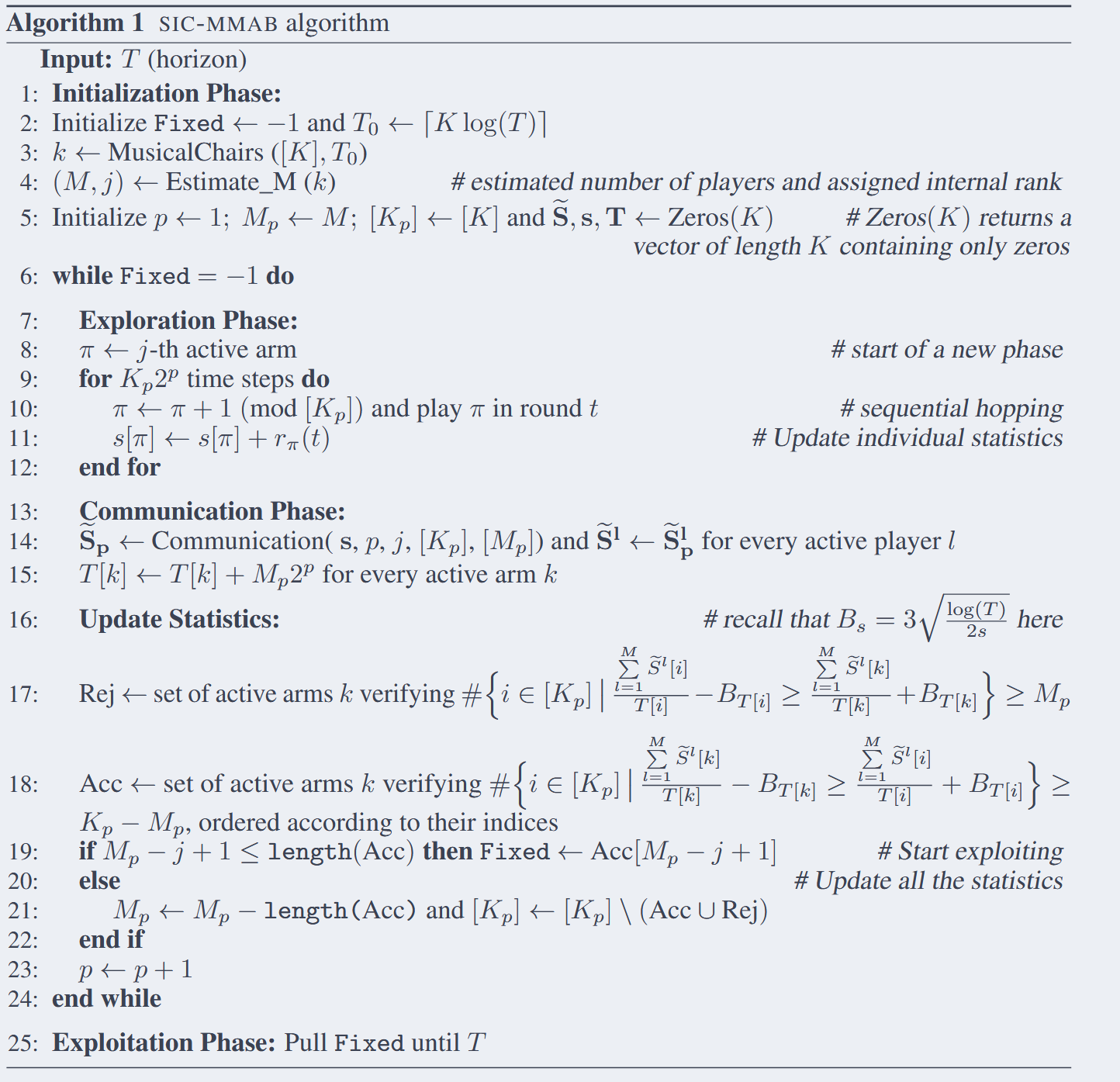
Distributed Algorithms for Multi-Agent Multi-Armed Bandits with Collision使用的算法和这篇是类似的, 使用的是round robin式的arm elimination, 不同的是这篇文章每个循环有轮, 一共有个循环, 这个算法是完全的collision-free的算法.
- 但是注意的是这里和传统的方法不同的是这里用来计算的reward sum是截断过的, 所以在计算confidence interval的时候会多考虑一个不等式, 也就是要bound住阶段的量化误差, 这也能说明为什么为什么有一个系数
- 对于一个agent来说每一个轮之后,
- 要么对应ACC的arm sample 次,
- 要么对应每个候选的arm sample 次, 如果一个arm是候选arm, 那么他们总共会被sample 次
- 对于接受准则和淘汰准则, 和上面这篇文章都是一样的, 事实上只要最优臂的LCB比臂的UCB要更高即可, 次优臂的UCB比M的LCB更低就可以淘汰, 分析可以参考lemma5的内容
- 这里每轮sample 次这样可以使得需要传递的信息最多是(求和,并且每轮最多得到1的奖励), 这样只需要个二进制位就可以传递信息.
- 这里还有一个相当巧妙的设计, 就是传递的截断信息使用小数部分作为概率$$\tilde S=\begin{cases}\lfloor S\rfloor & o.w.\ \lfloor S\rfloor+1 & prob. , S-\lfloor S\rfloor\end{cases}$$这样 , 所以在期望的条件下传递的数据就是实际的数据
2.1. Regret
exploration阶段的regret可以分为两个部分, 其中一个部分是和single-agent相同的部分, 也就是次优臂选中造成的regret, 另外一个部分是multi-agent特殊的部分, 也就是没有早点选中最优臂而造成的损失, 其中这里代表全局exploration的步数(单人的!不用乘), 这里代表的是k的总采样数:
2.1.1. confidence bound
- 对于arm elim 或者 UCB 式的算法通常第一步就是要通过 confidence bound 来得到高概率(good event)下的最大pull arm次数:$$s_k = \mathcal{O} \left( \frac{\log(T)}{(\mu_k - \mu_{(M+1)})^2} \right),$$或者对于suboptimal arm也是相似的只不过
- 这里得出一个结论是有关于两次communication之间的关系$$T(p+1)\le 3 T§$$通过2的指数的求和和的递减可以得出来这个结论. 这里可能和lemma7所新设计的机制是等效的?只不过那篇文章可以控制速率?
2.1.2. regret for suboptimal arm
这一部分是最简单直观的, 直接把结果带进去就行了
2.1.3. regret for optimal arm
- 这一部分是相对于single-agent的区别, 这一部分首先要bound住这个term, 这个term只需要记住我们前面所说的均匀采样次数很快就能bound住
- 具体是怎么利用这些条件进行证明的, 可以直接看论文.
3. Communication cost
- 对于第p个phase, M个agent直接两两传递, 两个arm之间要传递个arm, 每两个agent之间传递的数据量是, 所以传递一共需要轮, 而regret要对于所有的agent产生所以还要乘.
- 接下来bound住communication的total round, 这是由于所有的Acc arm均被Acc来bound的, 所以这个时间与和 arm之间的分离有关
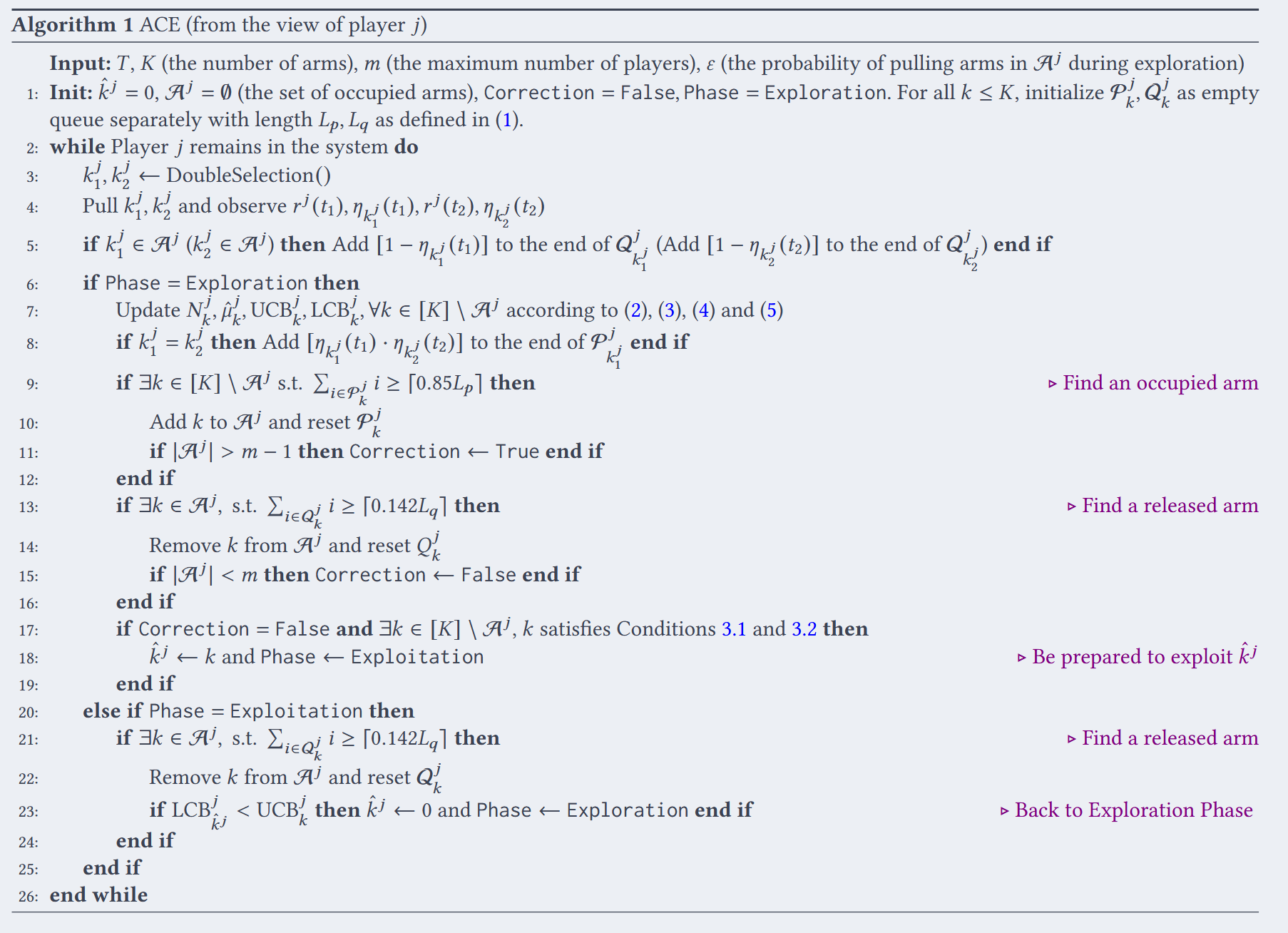
4. algorithm
Q&A
- 为什么是次? During the p-th exploration phase, each arm is pulled 2p times and its performance is estimated in a Successive Accepts and Rejects fashion [22, 12].
- A: 首先就是方便计算在p轮之后每个arm的总sample次数, 因为实际上可以转换为等比数列求和的问题. 其次一个, 使用这样的double trick的方式进行处理, 很容易得到和之间的scale关系.
takeaway
- The horizon T is assumed known to the players (for simplicity of exposure, as the anytime generalization of results is now well understood [14]). 这里是说假设players知道horizon的假设是没什么问题的, 因为可以通过double trick扩展到任意时间的泛化.
(across agents) ↩︎